Strategy guide
Split and starve
The cheapest way to beat a strong army is often to leave it nothing to eat. This guide shows why armies go bankrupt, how one 10-gold Villager can starve three units, and how to keep it from happening to you.
Dominex follows the territory-and-upkeep rules of Sean O’Connor’s Slay, so the same idea wins games of Slay too. The numbers here use Dominex’s rules; see where the two differ.
The rule behind it
Every kingdom pays its own way
A kingdom is any connected stretch of two or more of your hexes. Each one has its own capital and its own treasury. Gold in one kingdom can’t pay for units in another, even when the two sit a hex apart.
That makes a kingdom’s shape part of its economy. When land splits, the piece with the old capital keeps all the gold. Every other piece of two or more hexes gets a new capital with 0 gold and must pay its units from its own land. A unit left on a single hex has no kingdom at all, and it becomes a grave by the start of its owner’s next turn.
Gold lives in the capital. Cut a unit off from the capital, and you cut it off from the gold.
Upkeep
What strength really costs
Each rank costs three times the upkeep of the one below. Every hex without a tree or grave earns 1 gold a turn, so you can read upkeep as land: the number of hexes a unit needs behind it just to break even.
| Unit | Strength | Upkeep a turn | Hexes to pay for it |
|---|---|---|---|
| Villager | 1 | 2 | 2 |
| Spearman | 2 | 6 | 6 |
| Knight | 3 | 18 | 18 |
| Baron | 4 | 54 | 54 |
Combining makes this sharper. Two Villagers cost 4 a turn; combined into a Spearman, they cost 6. Four Villagers cost 8 and can stand on four different fronts, while the Baron they combine into costs 54 and guards one place.
Units can’t be sold, disbanded, or split. Undo reverses a purchase until you end your turn; after that, the unit stays on the bill for as long as it lives.
Buy strength to break a particular defense, not for its own sake. A Knight that has taken its castle still costs 18 a turn.
Watch Build an Army You Can Afford · 1:15Timing
When the bill comes due
At the start of each player’s turn, every kingdom they own collects 1 gold per hex without a tree or grave, then pays its units. If the treasury plus that income can’t cover the bill, every unit in the kingdom becomes a grave and the treasury drops to 0. There is no partial payment and no choosing which units to keep.
This happens before the player can move. A kingdom you cut on your turn can’t be repaired by its owner: by the time they act, the bill has already been paid or missed. The same is true for you. If a rival cuts your kingdom on its turn, the check runs at the start of yours.
Graves earn nothing, and at the start of the owner’s next turn each one grows into a tree, which earns nothing until a unit chops it. A starved kingdom stays poor after its army is gone.
Bankruptcy is settled before anyone can respond. Plan your cuts, and your defenses, a turn ahead.
A real move
Cut the link
This position comes from a real match on Stonefold. In round 14, purple’s 19-hex kingdom earns 19 gold a turn and pays 10 for three units, comfortably in profit. But its army sits at the far end, joined to the capital by a single hex.
A real move · Stonefold, round 14


- Purple kingdoms
- 1
- Army’s gold
- 4
- Army’s units
- 3
A 10-gold Villager takes that hex, and purple becomes two kingdoms of 9 hexes each. The capital’s half keeps the 4 gold but has no units to pay. The army’s half gets a new capital with 0 gold, earns 9 a turn, and owes 10. At the start of purple’s next turn, all three units become graves without a fight.
Count the hexes on each side of a link, not the size of the army. A profitable kingdom can be one hex from bankruptcy.
Watch Split and Starve · 1:02The treasury
Take the capital
A capital holds its kingdom’s gold and defends its own hex and the hexes beside it at strength 1, so a Spearman can take it unless a stronger piece stands nearby. Capture it, and the gold is gone. If at least two connected hexes remain, the kingdom gets a new capital that starts from 0.
The units are still there, but the savings are not. A kingdom whose upkeep is higher than its income was living on that gold, and it goes bankrupt at the start of its owner’s next turn.
Check a rival’s treasury before you choose. When it holds a lot of gold, the capital is the prize.
Defense
Guard your own links
Look at your own kingdoms the way a rival would. Find any hex whose loss would split land off from its capital, then ask whether the cut-off side could pay its units from its own hexes alone. If it could, a cut costs you land but not the army. If it couldn’t, that hex needs protecting.
A castle costs 15 gold, has no upkeep, and defends its hex and the hexes beside it at strength 2, so only a Knight or Baron can break through. A unit beside the link works too, but it adds to the bill. You can also widen the link by taking the hexes around it, so that no single capture splits the kingdom.
Turn on Show current enemy threats to see which of your hexes rival units can reach next. Joining your own kingdoms helps as well: one large kingdom can pay for units that two small ones can’t.
A 15-gold castle on the right hex can protect a whole army’s pay.
Reading the board
Pick the kingdom to starve
Tap any rival kingdom to see its gold, income, upkeep, and what its treasury will be at its next turn. The best targets show up in those numbers and in the kingdom’s shape:
- Little gold, upkeep close to income. Losing a few hexes can tip it over.
- An army far from its capital. A narrow neck of land between them is the place to cut.
- Expensive units. A Knight needs 18 hexes behind it and a Baron 54. Cut a kingdom near its middle, and the far half rarely has them.
- A large treasury. Taking the capital destroys it.
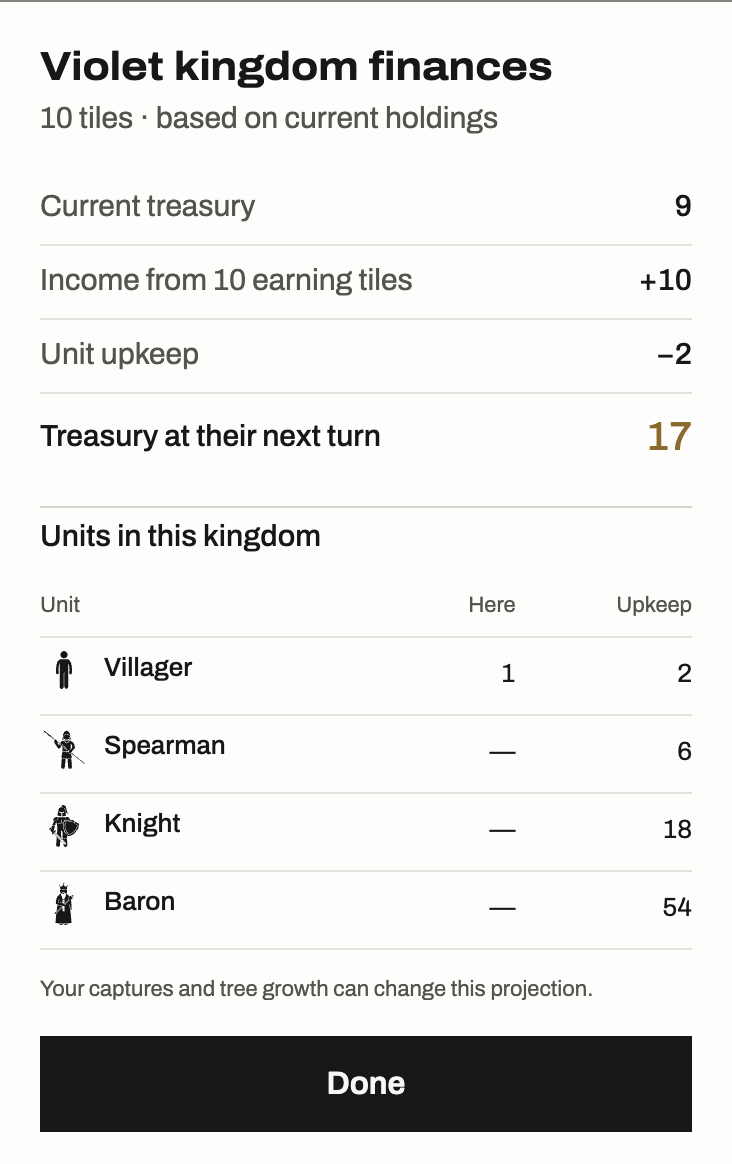
Read their books first. The weakest kingdom on the board is the one closest to its upkeep.
Every turn
Before you end your turn
-
1
Can every kingdom pay?At risk on the gold counter means a kingdom can’t cover its upkeep, and the game warns you before you end the turn.
-
2
Which links hold up an army?Guard any hex whose loss would leave units on land that can’t pay for them.
-
3
Which rival link can you take?A Villager costs 10 gold and can be bought straight onto an undefended border hex.
-
4
Do you need everything you bought?Undo still works until you end the turn.
Find the hex that holds a kingdom together
Four Core maps, one daily map, and every difficulty level are free. No ads. No account or card required.